Tuesday, September 20, 2005

Working in Sumatra - huge thanks to the STCP

We spent a fortnight working together with the Sumatran Tiger Conservation Program. Having travelled up from Jakarta through West Java and via ferry to southern Sumatra, we then embarked on an uncomfortable but enjoyable journey - crammed like sardines amongst all our kit - that took us half way up the bumpy roads of Sumatra, interviewing people and filming wildlife and palm oil along the way. Finally we arrived in the beautiful natural forests that the Tiger Protection Units patrol. With the help of STCP we filmed elephants, gibbons, hornbills and a beautiful variety of Sumatran wildlife. This incredible biodiversity demonstrates all that is in jeopardy through the growth of palm oil - the mono-crop main character of the film - that is replacing these natural forests at a rapid rate throughout Sumatra and Kalimantan.


Evie filming confiscated skins, bones and teeth at STCP Field Station

We also spent valuable time on the oil-palm plantations whilst working in Sumatra. They're everywhere you look and hard to avoid. Even many private gardens house a mini nursery of palm oil saplings to sell. Wildlife conflict was in evidence wherever we went. Simpai (leaf monkeys) in stranded tree stands deep within oil palm plantations, elephant damage in the plantations where they had been driven out of their forests by the illegal loggers (able to penetrate the valuable timber forests), unusual pets found in the plantation tethered up round every corner.


Nick with field coordinator Pak Yunus (left) and some members of the TPUs


We would like to thank Pak Waldemar, Pak Daniel, Pak Yunus and Pak Neil, along with all the dedicated members of the Sumatran Tiger Conservation Program and their Tiger Protection Units for their immense help and good humour whilst we were shooting with them in Sumatra. Thanks to their shared enthusiasm for the project we managed to shoot a huge amount of great material that will be invaluable in telling the palm oil story. Please visit the site of the Sumatran Tiger Conservation Program - the work they are doing is incredibly important, and they are tirelessly committed in their efforts to protect the critically endangered Sumatran Tiger. They deserve our support.


Tuesday, September 13, 2005

First Images from the Film: Another Crude Oil

We're back in England now, and are reviewing our footage and working quickly to get the documentary together. Here are some of the first images we have reviewed since our return. Still frames from "Another Crude Oil":


Film Frame from "Another Crude Oil" copyright Cockroach Productions 2005

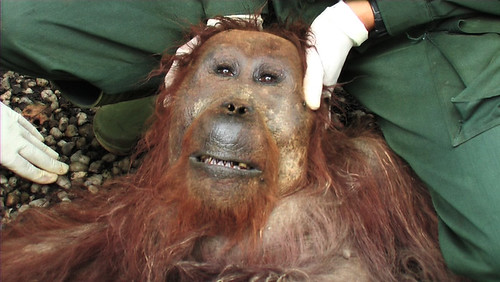
Above: A female orangutan in shock. Here her head is cradled by a BOSF paramedic as the team work to stitch up her knife wound from an attack on the oil palm plantation.


Film Frame from "Another Crude Oil" copyright Cockroach Productions 2005

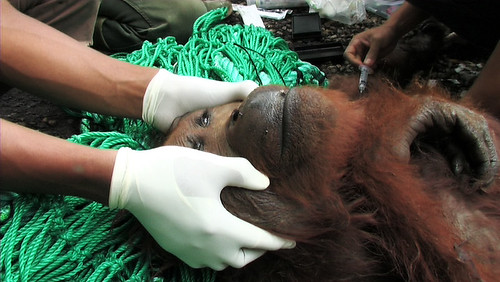
Above: Eko, a BOSF paramedic, draws blood for routine tests for Hepatitis A, B, C; Herpes Simplex 1 & 2, HIV and Tuberculosis.


Film Frame from "Another Crude Oil" copyright Cockroach Productions 2005

Above: Eko works to close a wound on the female orangutan's hand.

Post-production for the film is now underway. We are entering our second round of fundraising and sponsorship negotiations. Please contact us if you would like to become a part of this effort by supporting our film, and making these images of suffering a thing of the past.

cockroachproductions@gmail.com

Thursday, September 08, 2005

Meet the characters: Chanee - Radio Kalaweit

On Location: Radio Kalaweit, Central Kalimantan, Borneo
July 2005

"Thousands of orangutans, gibbons and other animals are now exterminated by bulldozers to create enormous palm oil concessions. Every day, our radio station (Kalaweit FM) broadcasts messages to sensitise people about the oil palm issue in Indonesia" Chanee, Radio Kalaweit.


Nurpradawati, Chanee and their son, Andrew outside Radio Kalaweit

One of the characters you will meet in the documentary is Chanee. Originally from France, Chanee now lives and works in Palangkaraya, Central Kalimantan,where he and his wife, Nurpradawati, founded the radio station 99.1 Kalaweit FM. Radio Kalaweit mixes popular and mainstream Indonesian music with an environmentally-friendly and educational focus - regularly broadcasting messages informing the listeners about the negative impacts of the illegal animal trade and the detrimental impacts of capturing wild animals to keep as pets, as well as providing advice on what to do if you do come across an illegally captured animal. The station has massive popular appeal - particularly with the young of Kalimantan - and the number of listeners continues to grow. Chanee is now planning the to extend the geographical range of the station's broadcast capabilities across Kalimantan. Chanee's idea to establish Radio Kalaweit stemmed from his long term involvement in, and committment to, saving the gibbon. Chanee started out working in zoos in France, until, becoming disillusioned with idea of keeping animals in captivity, he travelled to Thailand in order to help with gibbon conservation in the wild (it was here that he got his name - "Chanee" means "gibbon" in Thai). Following the huge forest fires that destroyed vast quantities of forest in Kalimantan and kept much of South East Asia under a blanket of thick smog for months in 1997, Chanee successfully gained permission from the Indonesian government to establish a gibbon sanctuary in central Kalimantan. His gibbon island, near to Palangkaraya, has provided a sanctuary for gibbons confiscated from those keeping them illegally as pets ever since.


A victim of the illegal trade in gibbons

With financial support from the Arcus Foundation, Chanee then established Radio Kalaweit (kalaweit meaning gibbon in Dayak) having perceived the importance of education amongst ordinary Indonesian people in the struggle to protect the gibbon from extinction. The station now has so many committed listeners that Chanee often receives animals from owners who have felt pressurised into giving them up by the sheer weight of disapproval from their friends, neighbours, and relatives. Through providing listeners with information, encouragement, and advice, Radio Kalaweit is taking very positive steps in developing a public awareness of, and aspiration towards, wildlife and forest conservation in Kalimantan.

Friday, August 05, 2005

Return from Kalimantan, Next Destination: Sumatra

Earlier this week we finished shooting in Central Kalimantan, following a successful field trip to Danau Sembuluh and Tanjung Puting National Park. We spent two days filming interviews and talking to people in the villages surrounding Lake Sembuluh, where everyone has a story, either about hardship caused by the encroachment of palm oil plantations, or about encountering wild animals such as orangutan, sun bear, and mouse deer who no longer have enough forest left to avoid encounters with local human populations. On the eastern borders of Tanjung Puting National Park a plantation-built track (running 6.4km into the park) has been made for the express purpose of facilitating illegal logging. The more degraded the national park land becomes through illegal logging, the easier it is for the palm oil companies to win concessions for the forest - why protect forest which has already been destroyed? You can hear the chainsaws working.

Tomorrow we leave for Bukit Tigapuluh National Park in Sumatra, where we plan to film the work of the Sumatran Tiger Conservation Program. Sumatra has a longer history with palm oil, some of the estates being over 100 years old. Still the expansion of oil palm and also the pulp and paper industries is putting serious pressure on natural forest. The World Bank estimated that all un-potected lowland forest would dissappear from Sumatra by the end of 2005. Let's hope this is not going to be true. There are certainly some very dedicated people working in the STCP who are working on expanding park boundaries and with it protected lowland areas. These areas are home to the Sumatran Orangutan (with only 7000 left in the wild) and the Sumatran Tiger (with only 500 left in the wild!). There are numerous other endangered species in these forest and we hope to capture footage of some of these over the next few weeks.

Thursday, July 28, 2005

Working with Orangutans

Orangutans are not all sweet and nice. Most of the babies are... the problem is that when you're filming and there are forty babies around you - the nice ones will be contemplating deep thoughts by themselves, or playing with each other, or lazing in a swing, or snoring flat out on their backs. The one in ten that aren't so chilled out will wait till your back is turned and come and bite you on the bum, or the ankle, or the knee or your big toe. It bloody hurts. When one of them grabs hold of your clothes you can expect a 10 minute tug of war before you're free. Of course this kind of behaviour is reserved for visitors - the orangs are fully aware they can't get away with this with their babysitters.


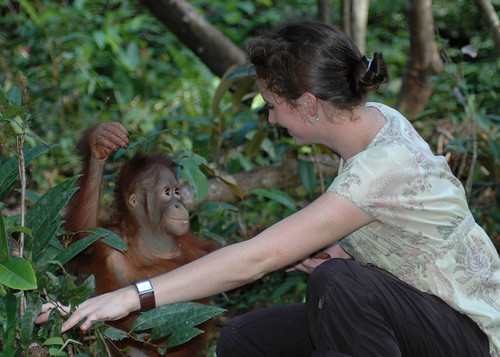
Evie, the director, getting to know one of the characters.
photograph courtesy of Sean White

If you are lucky enough to be approached by one of the more friendly babies then you have a very different experience., and nothnig beats it. As time goes by you recogise the individuals that are out to get you and learn to run when you see them coming. I'm sure we looked ridiculous as we threw our cameras and tripod over the shoulder and ran for it when a small ball of orange hair trundled towards us, but they have sharp teeth, and they'll climb you like you're a tree. The DVD extras for the documentary may well come packed with wobbly shots as the camera is hoisted up quickly in the face of a charging minature ape, or wrestled from the grip of an overinterested baby.

Nick, the producer, getting to know one of the characters.
photograph courtesy of Sean White

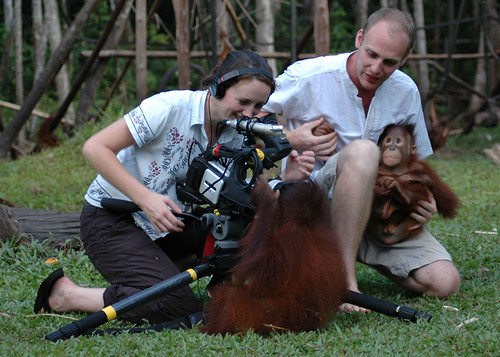
Photographing orangutans is fun because they love looking into the lens. Its not like normal wildlife photography. You are working with a self-consious subject who shows a huge amount of interest in what you are doing. Sometimes there's a bit too much interest and the orangutans volunteer themselves as camera assistants. We had help with focus pulling, panning and in the grip department. Unsurprisingly the results weren't great, but at least nothing was broken.

Trying to cope with increasing involement in the filming process.
photograph courtesy of Sean White

Thursday, July 21, 2005

Danau Sembuluh and Tanjung Puting

We're now about half way through our time filming here in Kalimantan and things are progressing very well. Tomorrow we are filming interviews with the local people living in the villages surrounding Danau Sembuluh. We've been fortunate enough to find contacts in WWF and Wahli here in Palangkaraya who know the local dialect and will beable to act as both translators and interviewers. A lot of new concessions for plantations in the area are currently being processed, and the villagers will in all probability lose all their land rights and so too their current means of subsistence. Of course, the destructive effect of the spread of palm oil on the local population is no less devastating than its effect on the environment, and this will be a primary focus in the film.

We are then visiting the Tanjung Puting National Park. This was for many years the only area granted national park status in Central Kalimantan, and was made famous through the work of Birute Galdikas, one of the original three "big name" female primatologists who worked under the tutelage of Louis Leakey, together with Dian Fossey and Jane Goodhall. Sadly, the borders of Tanjung Puting, which houses not only orangutan but also large populations of proboscis monkeys, slow lorises, sun bears, leaf monkeys, tarsiers, hornbills and more are now being lost to the incursion of the palm oil plantations. Through a legal loophole, three different palm oil conglomerates have recently been granted concessions for plantations which intrude a mile into the Eastern border of the national park land itself. Tanjung Puting is world famous due to the diversity and rarity of the species which inhabit it. We plan to film some of the logging sites which are already destroying large areas of this precious habitat.

Friday, July 08, 2005

Notes from the field

Friday 8th July 2005
Orangutan Film Protection Project
On location: Nyaru Menteng, Central Kalimantan

I wake at 06:00am. My sarong is wrapped around me, it got cool through the night. This won’t last long, the sun is rising and the humidity is high. Evie hasn’t slept so I leave her in bed whilst I walk back to the centre to check in with last night’s arrivals. They are still in their crates, but the larger male is due to be looked at first. I wander around near the gate shooting some footage of fruit being prepared for the orangutans. The sickly sweet smell of jackfruit hangs heavy in theair. There is a light drizzle and I struggle with the umbrella and camera.
Just as the team unload the crate from the pickup Evie arrives. She managed to get an hour’s sleep – it will have to do – she needs to film the setting of the leg. We both know I might pass out. Indra is trying to get an angle with the blowpipe. It’s harder than one might think – it’s dark in the crate and there are limbs in the way. Jhon tries to illuminate the scene with a torch. The shot’s in but not all the sedative injected. Eko lifts the crate door and an arm grabs for something, so they quickly and carefully lower the door to pin the arm down. The rest of the sedative is administered. Eko looks to me and says he’ll call this one Nick, is it ok? Sure, I’d love to have an orangutan named after me. There’s no more movement from the crate. Jhon shakes the crate gently to see if there is any reaction. There is not.
With the crate door up they pull it backwards to reveal the orangutan. On closer inspection Eko informs me that “Nick” is a female of 11-12 years...
There is a large medical kit on the floor: stethoscope, suture kit, syringes, antiseptic, bandages and viles of medicine. I film cut away shots and zoom to get a closeup of the needle as Eko clears the air bubbles. A drop glistens in the sun as it makes its way down the needle. Indri is holding the patient’s head. She is treated with gentle tenderness. There is a deep gash on one of her fingers. I can see the white of the bone amid the semi-congealed blood. I ask Eko whay happened.
Eko: She’s from the sawit (palm oil plantation). The workers attacked her with...I don’t know in English.
Nick: Dalam Bahasa Indonesia
Eko: Dengan parang
Nick: a knife...

Evie and I knew these sorts of encounters between the orangutans and plantation workers were common, but we didn’t expect to witness the results as soon as we arrived. I’m filming as Eko disinfects the wound, but when he brings out the needle and thread Evie instinctively take the camera from me. I try not to look too much, Evie say it is gross. We shoot close ups of the patient’s face throughout the check-up procedure. She is not unconscious, just immobilised. She watches Evie and I. We are standing a little way back to give the team room to work. She looks to be in absolute shock. 12 years in the jungle, learning her territory, fruiting times for different trees, medicinal properties of different plants. Everything has changed now. Palm oil has replaced her home and she has suffered an encounter with scared men with knives. Now she will be put in a cage...I’m not sure when or where she will be released. Suitable territory is disappearing at an alarming rate. Her lip is trembling. I don’t know if this is due to the sedative or the shock. It leaves me deeply disturbed.
Neither Evie nor I have seen footage like this before. Maybe television won’t buy it, but it needs to be seen. People need to know what is happening here.
Lone says that last week a plantation called up to say that they had caught an orangutan – BOS try to stop them from doing this – without a tranquiliser dart the only way this can be done is by beating the orangutan. The team arrived to find the orangutan tied down so tightly the hands were almost severed – it died shortly after. If they’d called the centre and not attempted to catch it this orangutan would still be alive.
We film the leg setting in the afternoon. Although it’s a more traumatic operation the young male doesn’t seem as affected by it as the ordeal of the older female. The broken leg was an accident. The cut was a result of an attack. For a young orangutan there are constantly new experiences and encounters – every day is a learning experience. He will, no doubt, be scared – but perhaps this is not so disturbing as the situation of an older more experienced orangutan finding itself in traumatic circumstances.
The power cuts out again tonight. We eat in the dark cavernous house. The candlelight illuminates numerous rats, and a couple of bats circle around the eaves. The reassuring sound of geckos tells us that at least something is eating the mosquitoes that are eating us. In my sleep I dream of six-foot tall rats.

Thursday, July 07, 2005

Notes from the Field

Thursday 7th July 2005
The Orangutan Film Protection Project
On Location: Nyaru Menteng, Central Kalimantan

First day at Nyaru Menteng and a rescue team returns. The sun has already set and the flash of headlights announces the car at the gate. We’d been walking back towards Aula to have dinner and settle for the evening. With the rescue back we run into the office to grab the camera, rig the mic and pick up a spare tape and battery. There’s very little light. The stars are out, but we have a narrow window to see them through the surrounding trees. It’s good to be out of Jakarta with its orange sky at night. We film by torchlight. There are two crates in the back of the pickup. The yellow glow of torches reflects of the ventilated aluminium sides, preventing us from clearly seeing the occupants. The captives are quiet, perhaps in shock. They will have been tranquilised before they were moved into crates – wild orangutans are strong and independant-minded.

We’re told that the young male has suffered a broken leg. The team splinted his leg in the field, before moving him; but Lone feels his foot and it is cold. She is worried that the bandages might be too tight. Lone talks with Eko and they decide to resplint the leg before morning. The team lift the crate off the pickup and put it in fornt of the car’s headlights. The power cut out a few hours earlier so the car is the best availabel source of light.

I’m squatting on the ground between the headlights. There’s enough light to film here and I’m not getting in the way. The slight exertion starts me sweating, again. Eko administers more sedative to immobilise the young male. Lone comments that he’s more placid than most orangutans of this age when first caught, even so, he needs to be still for Eko to work on his leg. The break is in a tricky position – his right femur just above the knee joint. It would have been easier to immobilise the bone if the break was in the middle. Tonight’s splinting is only a temporary measure. Tomorrow Eko will set the bone straight and put it in a cast.

I’m getting tired – we only flew in this morning and were up late last night packing and sending vital emails from Jakarta. Evie takes the camera and continues to shoot. Evie and I are both exhausted, but the natural adrenaline release brought on by witnessing this event keeps us going. Once the leg has been resplinted Eko gives the orangutan another injection to rouse it from it’s sedation. The team moves quickly to get the orangutan back into its crate, the drug is fast acting and he begins to stir immediatley. Lone covers him with blankets and puts some hoter water bottles in the crate – he’s still cold. The team will work on his leg again tomorrow, when it’s light. The larger male’s wounds are not so serious – he will stay in his crate until morning. The cages at the centre are full, there are too many orangutans coming in. Lone will have to find room in the morning.

We finally head back to Aula. From the track there are a network of wooden walkways traversing the peat swamp. Our house sits on stilts above the swamp. We’re locked out. Luckily Lone is with us. She is small so we manage to help her through a small, high window. We’re grateful we don’t have to spend the night on the stoop. Inside the barn-like pondok there are high vaulted ceilings. The cooler evening air hasn’t yet cleared the day’s heat. The third room we try has a fan that works. I set to stringing our mosquito nets in a way that we can walk around the room without clothes-lining ourselves. Evie fills up our wooden shelves with dried and tinned food that we brought from town. We’ve misplaced our water bottle. Evie brushes her teeth with apple juice, I just go to bed. The fan struggles to send it’s breeze my way, my mosquito net absorbs what little reaches me. I fall asleep at once. Evie is kept awake by the rats in our room throughout the night.

Wednesday, July 06, 2005

Thanks to BOSF and the Pusat Primata Schmutzer


Photograph BOSF Communications and the Team(L-R): Nick, Willy, Yudhi, Lili, Sally and Evie.

We would like to extend our gratitude to the BOS Foundation Communications team based at the Pusat Primata Schmutzer in Jakarta - for their support in the last few weeks. With the help of this team we have now acquired all the neccessary permits for filming in Kalimantan, and are due to leave this Thursday. We are also very grateful for the invaluable advice and enthusiasm of Pak Made, Colin & Hannah.

Monday, July 04, 2005

Pusat Primata Schmutzer, Ragunan Zoo, Jakarta


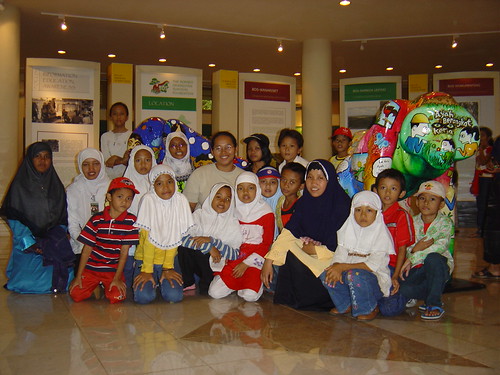
The Ragunan Schmutzer Primate Centre was donated to Jakarta by the late Mrs. Puck Schmutzer and the Gibbon Foundation. It was opened in 2002, and now houses 22 species of primate, including orangutan, gorillas, chimpanzee, and several species of gibbon. School groups visit the centre and are taught about the importance of primate protection and habitat conservation by volunteers, most of whom are students and recent graduates. Today we spent the morning filming a group visit from the Al-Akhyar school in Jakarta, shown in the photo. The existence of this educational facility provides some hope for the orangutans of Kalimantan and Sumatra. Thanks to Kus and Siska from the primate centre for their help and enthusiasm today.

Saturday, July 02, 2005

Going Undercover

Today was a successful but emotionally draining day, spent documenting a show which featured orangutans. The show had the orangutans in clothes, riding bikes, playing doctors and nurses, dancing… exploitation of an endangered species.


As the oil palm plantations stretch further and further into the Kalimantan forests, the habitat of the orangutan diminishes, meaning that they are much more vulnerable to the illegal trade which may result in them spending a life such as that led by the orangutans we met today – kept in tiny cages, the only ‘relief’ being to perform a show several times a day to amuse the paying public audience.

How to make a Donation

We've had a couple of enquiries about how to donate to the project, so we hope this will help. For people in the UK you can write a cheque payable to Cockroach Productions and send it to:

Cockroach Productions,
The Old Tannery,
Staplegrove,
Taunton,
Somerset,
TA2 6SP

For supporters outside the United Kingdom, we ask that you email us at:
cockroachproductions@gmail.com

and then we can advise you how to transfer funds. Please note that posting messages directly onto the blog does not give us your reply email address, so if you wish to contact us please email the address above.
The Team has just returned to the UK (September 2005), and we are now getting stuck in to the editing process. We still need help. We have stunning and powerful images that tell the story of palm oil and the social and environmental disaster that is surrounding it - we need your help to get this message out. Please help.

Thank you for your generous support, and best wishes from the OFPP team.

Friday, July 01, 2005

On Location - Pusat Primata Schmutzer, Java, Indonesia


Today we started shooting the first Indonesian footage for the film: a good start to the new month. We are now staying at the Pusat Primata Schmutzer (Schmutzer Primate Centre) where we are building up footage of the education programmes that teach Indonesian children about the concepts of conservation and the variety of primate species in Indonesia, and the threat that many of these species are facing with logging and plantation concessions and illegal activities. Through this we are hoping to illustrate the efforts being made locally to protect the future of the forests and their inhabitants.

Wednesday, June 29, 2005

Help make a difference to this site!

We are just about to start filming, and we will be writing up what we are doing and the stories along the way. This board will therefore be getting a bit more exciting and we'd like to be able to post up some photos from the field. We are therefore looking for someone to help us get a digital stills camera so we can make this page a bit more interesting to look at. The images we shoot can then be used by our sponsor for their own publicity purposes too.

If you're interested in helping us with this then please contact:
cockroachproductions@gmail.com

Help get some images up on the page and we'll get your name up on the page! This is a not-for-profit venture, and the project has been made possible through the support of many people and lot of time and effort. All the photos on this page have been taken when we've managed to borrow a digital camera, but this is not always possible and not always high quality. We need your help...

Thanks to SONY

We would like to thank Sheila O'Brian from SONY. Its always hard to get the interest of big companies in particular projects, so when we find someone who makes the effort to help us we really appreciate it. A big company does well to have a such individuals.

Thanks to Australian Airlines

I'd like to say a big thanks to Catherine Wake and Casey Avard at Australian Airlines for sorting out getting out film equipment into Indonesia at the last minute. Its help like this that has made the project possible and we would have been stuck without you.

Thanks to John Barry

Thanks to Vince Clark at John Barry for helping us complete our kitlist. We now have a our boom and headphones and will start working on the sound library soon.

Wednesday, June 15, 2005

Progress Report

Quick Update: The Indonesian Embassy has given us the all clear for the film project and we are getting our journalist visas. We will be leaving Sydney for Indonesia on Wednesday 22nd June, and commencing shooting soon after.

Monday, June 06, 2005

Thanks to MAXELL

The OFPP would like to say a big thank you to Mohan and Alfian, our new friends at MAXELL Singapore for helping us by providing the miniDV tapes on which we will be shooting the project. This is a great help to us, and will give us a reliable medium for capturing our precious images.

Wednesday, June 01, 2005

Male Orangutan - The Thinker


the thinker
Originally uploaded by Nick Lyon.

North Sumatra, Indonesia 2001