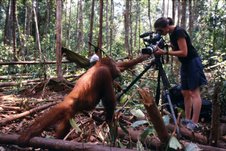
Dawn with the Gibbons, Central Kalimantan
Filmed by Pramudya Harzani (Cockroach Indonesia), Edited by Nick Lyon (Cockroach Productions).
www.cockroach.org.uk
www.films4.org
Filmed by Pramudya Harzani (Cockroach Indonesia), Edited by Nick Lyon (Cockroach Productions).
www.cockroach.org.uk
www.films4.org
A new film from our friends at the Environmental Investigation Agency
Every year 2.8 million hectares of Indonesia's forests are illegally felled. The vast profits from this trade benefit a small minority of ... all » powerful timber barons with little or no return for local people.
This film shows how civil society groups in Indonesia have joined together to tell their story and press for change in the major market for unsustainable timber - the European Union.
6 February 2007

24th Session of UNEP’s Governing Council/ Global Ministerial Environment Forum 5-9 February 2007.
The report says that natural rainforests of Sumatra and Borneo are being cleared so rapidly that up to 98% may be destroyed by 2022 without urgent action. The rate of loss, which has accelerated in the past five years, outstrips a previous UNEP report released in 2002 at the World Summit for Sustainable Development (WSSD) Then, experts estimated that most of the suitable orangutan habitat would be lost by 2032.
The illegal logging, driven by global demands, accounts for tens of millions of cubic metres annually and an estimated more than 73% of all logging in Indonesia. Approximately 20% of the logs are smuggled directly out of Indonesia, the remaining is used to support an extensive international and local wood industry, and then exported to the international markets by well-organized, but elusive commercial networks.
New satellite imagery reveals that the illegal logging is now entering a new critical phase: As the demands grow, the industry and international market are running out of cheap illegal timber and are now entering the national parks where the only remaining timber available in commercial amounts is found.
Satellite images confirm, together with data from the Indonesian Government, that illegal logging is now taking place in 37 out of 41 national parks, and likely growing. “At current rates of intrusions, it is likely that some parks may become severely degraded in as little as three to five years, that is by 2012”, says the new study “The last stand of the orangutan: State of emergency.”
Overall the report is concluding that loss of orangutan habitat is happening at a rate up to 30% higher than previously thought. The report, compiled by a wide range of experts, is being launched at UNEP’s 24th Governing Council/Global Ministerial Environment Forum. Here, close to 100 environmental ministers and state secretaries are meeting under the theme of globalization – environmental risks and opportunities
Indonesia is active in fighting illegal logging and has worked with a series of international programmes and initiatives to reduce the logging. However, says the report, while many of these initiatives are valuable, they require the assistance of the international community to stop the demands for illegal timber, and they are also mainly long/term in effect. In response, the Indonesian government has on several occasions in recent years directly used support from the Navy and Army to arrest, confiscate timber and drive companies out of the parks.
Recently, the Indonesian government has launched perhaps one of the most promising initiatives in recent years, namely the training of specially equipped ranger units (SPORC) to protect the parks.
Achim Steiner, UN Under Secretary General and UNEP Executive Director, said: “Globalization is generating unprecedented wealth and lifting millions out of poverty. But in this case, the illegal logging is destroying the livelihoods of many local people dependent upon the forests while it is also draining the natural wealth of Indonesian forest resources by unsustainable practices. The logging at these scales is not done by individual impoverished people, but by well-organized elusive commercial networks“.
“National Parks form a cornerstone in the 2010 target to reduce the rate of biodiversity loss and are also so valuable for eco-tourism and in generating new livelihoods. Their protection is vital to these international goals and to the entire concept of protected areas”.
He called on governments and the international community to assist the Indonesian authorities with the equipment, training and particularly funding needed to enforce and patrol their national parks from illegal loggers.
H. E. Rachmat Witoelar, Indonesia’s environment minister and outgoing president of UNEP’s Governing Council, said; “We are currently in an unequal struggle over illegal logging, which in the medium to long-term could be won through certification processes. Such processes can help global consumers choose between sustainably produced wood and palm-oil products and those produced illegally and unsustainably”.
He said that the government was acting in the short term with counter measures including through the development of Ranger Quick response Units to counter illegal forest destruction. “However, the challenge of policing and enforcing Indonesia’s vast parks is immense and rangers have currently little access to ground vehicles, boats, arms, communications or aerial surveillance such as planes or helicopters. In 35 of our national parks we have over 2000 rangers but they have to patrol an area of over 100,000 km2”
The scale of illegal logging, including into national parks is likely to increase not only in Indonesia, but also in other parts of Asia, Africa and Latin-America. “The situation is now acute”, says Christian Nellemann, leader of the Response team. “The recent Indonesian initiatives on law enforcement will require the necessary scale, financial and logistical support in order to stop the extent of this illegal logging. If successful, the Indonesian experiences gained in the coming years may substantially improve our ability to protect national parks and fight illegal logging in other parts of the World“.
The report is prepared by GRASP, the Great Ape Survival Partnership lead by UNEP and UNESCO in collaboration with a wide range of NGOs.
Note to Editors:
Bornean and Sumatran orangutans are classed as Endangered and Critically Endangered and are listed on Appendix 1 of the Convention on the International Trade in Endangered Species of Wild Fauna and Flora (CITES).
Recent estimates suggest there are between 45,000 and 69,000 Bornean and no more than 7,300 Sumatran orangutans left in the wild.
The orangutans share their habitat with a wild range of other threatened and ecologically important species including the Sumatran tiger, Sumatran rhinoceros and Asian elephant. UNEP and the UN Educational Scientific and Cultural Organisation (UNESCO) have launched the Great Apes Survival Project (GRASP) in response to growing concern over the plight of the orangutan, chimpanzee, bonobo and gorilla.
The report “Last stand of the orangutan: State of emergency” can be downloaded at:
Copyright © 2006 ANTARA


Indonesia must certainly approach this yearly problem with a high degree of seriousness. In fact, Indonesia should ratify the ASEAN transboundary haze agreement. But Indonesia also has something to tell to its neighbors -- in particular those who harbor members of the corrupt elite, who move around like smoke.
The smoke from Indonesian forest fires has created havoc not only in various parts of Indonesia, but in Malaysia and Singapore too. The Malaysians, acting to protect their interests, have made an open demand to the Indonesian government to stop the fires. They have even brought the issue to ASEAN. Singapore, while reacting less aggressively, is also unhappy with the way Indonesia has dealt with the smoke.In an article written by Todung Mulya Lubis called Singapore Paradox (Kompas, Nov. 2), the nation-state is accused of abetting Indonesia's corruption problem. Singaporeans have argued corruption is rampant here because Indonesia has not made a serious effort to fight it. But Singapore itself is a safe haven for corrupt Indonesians. Thus, the paradox is that while Singapore claims to be one of the "cleanest" countries in the world, it provides a den for its dishonest neighbors.
Smoke and corruption have a common thread. Indonesia can argue that it does not intend for the fires on its territory to send smoke to neighboring countries. Smoke is spread by the wind, which is not under the control of Indonesian government.
By the same token, Singapore can argue it does not intend to spread corruption, since it has very strict laws in that matter. They might point out that corrupt people, from Indonesia or anywhere, can come and go to Singapore, as do other people from ASEAN countries. But the problem is, in Singapore they are not considered practitioners of corruption, but investors.
So, will the next ASEAN conference focus on smoke? If it does, Indonesia should raise the "Singapore paradox."
The problem of smoke is usually not discussed in terms of sovereignty. Since smoke is no respecter of borders, every country can demand that the country in question fix the problem. That makes sense.
Diplomats tend to view corruption, however, from the standpoint of state sovereignty. If Indonesia raises the issue of corruption in Singapore, it can be accused of interfering in Singapore's affairs and violating Singapore's sovereignty. It is the right of the Singaporean government to decide who can and cannot enter its sovereign territory.
The problem of smoke and corruption should be instead be understood from the perspective of "global public good." In her book bearing that term as its title, Inge Kaul argues that as globalization becomes intensive and extensive, the public good cannot be viewed simply in terms of one's country or region. What affects one country or region can affect countries around the globe. Pollution, for example, including global climate change and the greenhouse effect, are global concerns. So is oil policy. Global public good should overcome the constraints of sovereignty.
If clean air is a global public good, what about a "clean neighborhood"? The problem of corrupt people who move from one country to another should be tackled within that framework. "Good governance" refers to the fight against corruption at the national level, and a "clean neighborhood" policy would entail a similar effort at the regional and global level.
No country can argue that corruption is strictly a national problem. We are living in the era of globalization. Bad operators fly around the world and can move their money around the world with the click of a mouse. If one country wants to eliminate corruption, other countries must join its efforts, just as in the case of preventing global warming.
A "clean neighborhood" should be considered one of the "global public goods." It is high time to have a treaty to establish a clean neighborhood.
ASEAN may become a pioneer as the first international organization to tackle this issue. If it can force Indonesia to deal with the smoke, it should be able to put Singapore under similar pressure to cleanse its territory of both domestic and global corruption. That would create a truly clean neighborhood.
The writer is a lecturer on globalization at the Postgraduate School of Political Science, University of Indonesia.


Morrisons has announced its intention to join the Roundtable on Sustainable Palm Oil (RSPO), to further demonstrate its commitment to the responsible sourcing of this ingredient and to help promote the growth and use of sustainable palm oil.
The company will continue to work with its suppliers to make progress in ensuring that any palm oil used in own brand products is from verifiable, sustainable sources.
“We have always been in accord with the aim of the RSPO and to address the issue, we focused on working directly through our supply chain”, said Corporate Affairs Director, Chris Blundell. “Given the global nature of the palm oil market there is the need for collective action on an international basis and the Roundtable process provides the best means of achieving this.”