Wednesday, January 24, 2007

Palm Oil threatens 1600 Orangutans

Minister warns company for posing threat to 1,600 orangutans

Palangka Raya, Central Kalimantan (ANTARA News) - Forestry Minister MS Kaban has strongly warned the Makin Business Group for planning to open an oil palm plantation in an area which hosts the habitat for about 1,600 orangutans in Katingan district, Central Kalimantan.

"We have given the company a warning and asked it to save the life of orangutans in the area," Minister Kaban said here Tuesday night.

Kaban made the remarks during a meeting between Vice President Jusuf Kalla and Central Kalimantan`s regional government officials, mining, plantation and forestry businesses.

The minister said if not seriously reprimanded Makin Group`s plan could lead to the [loss] of thousands of orangutans in the area.

Therefore, he called on the business group to save first the rare animals in the area which was to be turned into a plantation.

"I think Indonesia has been under a heavy spotlight for incompetence in preserving its biodiversity," the minister said.

Makin Group is planning to open a 50 thousand hectare oil palm plantation in Katingan district, Central Kalimantan, in 2007.

In the area, there is a habitat for orangutans with a population of 1,600.

In the meantime, Assistant Manager of the Borneo Orangutan Survival (BOS), Hardi Baktiantoro, said the opening of the plantation in Katingan district was a serious threat to 1,600 orangutans in Kalimantan.

"Based on our data, the area, where Makin Group is to open an oil palm plantation, is host to some 1,500-1,600 orangutans. If the company resumes its planning, it will exterminate the rare animals," he [said].

He predicted the population of the Kalimantan orangutan would have been extinct by 2010 in line with the opening up of forests to make way for palm oil plantations.

"The biggest threat to orangutans is the expansion of oil palm plantations," he said. (*)

Copyright © 2006 ANTARA

Tuesday, January 23, 2007

Thursday, January 18, 2007

Shooting Diary - Notes from the Oil Palm

Tsunami-like devastation in the palm oil, surprisingly convincing acting from security guards, apocalyptic floods, and turtle rescues...

Shooting for the conflict-mitigation training film necessitated the inclusion of a re-enactment of palm oil workers following the correct procedure having encountered an orangutan entering the plantation boundaries. We arranged to film this re-enactment at a plantation about 7 hours' west of Palangkaraya, near the city of Sampit. The plantation in question was in the process of being established - and the land was being rapidly deforested, drained, bulldozed, and planted. This was previously prime orangutan habitat, and the BOS-F rescue team have made countless orangutan rescues from the small forest islands yet to be cleared in the vast new plantation. The small patches which remain are full of endangered species, competing for increasingly scarce resources and all slowly dying from starvation. An extract from our shooting diary…

Filming Deforestation No.2

“Unable to find a 4WD to hire, Pram and his friend Udin tracked down a fairly battered Kijang for the trip. We arrived at the plantation late at night, hoping to be able to find a couple of rooms in the workers' accommodation in which to stay. The plantation’s Indian-Malay manager was in town watching a World Cup match, but fortunately the satpam (security guard) let us use the room next to his (wooden slat floor for a mattress, hot and full of mosquitoes, but better than a night in the car).

DSC00230.JPG

The grey dirty water in the mandi next door was surprisingly effective at refreshing our already sweating and aching bodies at sunrise next day. We were up early to meet with the plantation staff manager, Pak Hari – a Sumatran with a love of Country and Western music and line dancing. Our tour of the clear-felled plantation in Pak Hari’s spotless and aircon-cooled pick-up was made more surreal by the in-car soundtrack of “Country Road” (interpreted by the famed Indonesian singer Tantowi Yahya). We arranged to film the reconstruction at daybreak next morning, and then set off in the Kijang in order to get some documentary evidence of the devastation wrought on the plantation.

The Horror

Forest clearance at this plantation was happening so rapidly and on such an extensive scale that Pram likened it to the 2004 Tsunami. Mile-upon-mile of fallen trees has replaced one of the most bio-diverse areas of the planet. Workers live under makeshift plastic shelters near the plantation’s edge, where the forest topsoil, not quite destroyed yet, has turned into a tar-like inky mud.

Fishing Hell's Creek No.3

They do have plantation accommodation, but the plantation is so vast that this would add a 14 mile hike to their daily grind, and as they work from sunrise to sundown, navigating the treacherous paths in the dark is no fun. There’s no shade and I had to shamefacedly revert to walking around with an umbrella, neo-colonial style, to hide from the blazing equatorial sun.

Road to Hell No.2

Although the Kijang had done well at navigating the extensively potholed road to Sampit, the thick mud of the plantation tracks proved too much for it and we almost immediately got stuck for several sunburnt hours.

Documenting Devastation No.2

After various attempts to free the car ourselves we were joined by a young plantation worker. Originally from Jakarta, he had left his job at a textile factory in the capital to come and find work in Kalimantan. Eventually it transpired that the plantation employed him as an “orangutan guard”. From 5am till 7pm it is his job to patrol a 3-mile section of the plantation perimeter keeping an eye out for desperately hungry orangutans damaging the palm oil saplings in search of food. According to him, the managers had recently ordered 300 snares to be set within the small patch of forest under his guard, in order to capture any orangutans remaining within it. We filmed an interview with him, Pram acting as interpreter. This snared forest patch and this guard were part of a much larger team operating along the plantation boundaries.

Destruction

At sunrise next morning, fortified by a paper bag full of deep-fried tofu sold to us by an ancient old man on an equally ancient pushbike, we set off to film the re-enactment. There were some early glitches – when our “actors” started shouting “Let’s kill it!” at the imaginary orangutan they were trying to scare back into the forest, we had to have a bit of a chat with them and shoot the scene again. Pak Johannes, the security guard, turned out to be a surprisingly competent and confident thespian, although his overly cautious motorbike driving (despite us leaning out of the window of the Kijang shouting “lebih cepat pak!” at him) meant that we were left worried about how to convey an appropriate sense of urgency in the scene.

Security Reports Orangutan Sighting

During our three days spent working and filming on the plantation, we heard countless stories of the suffering endured by the remaining wildlife that used to live in this forest. Workers responsible for forest clearance around the edges of the forest islands saw orangutans entering the plantation in search of food everyday. We found a captured gibbon, one of many caught and held captive on the plantation by workers, destined to be sold into the pet trade in Sampit and sent downriver on a logging boat to Jakarta.

Filming Illegally Caught Gibbon

Unfortunately we were powerless to release this gibbon… neither could we blame the guard. This was his job, and his salary could be traced back through management to the parent company and some big well-known investors and buyers. On the edge of the clearing the gibbon’s mate (gibbons are one of the rare pair-bonded primates) was screaming for its imprisoned partner. It was a disturbing scene.

Gibbon No.5

On the return journey, the trusty Kijang was again put through its paces. Extensive deforestation along the banks of the Kasongan River has made it prone to bursting its banks during heavy rain, and the road from Sampit to Palangkaraya travels alongside the riverbank for extended distances. The flooding on our return journey was severe – waist-height in certain places – and without a 4WD we shouldn’t really have been attempting to get through it. In typical opportunistic fashion, local villagers were spear-fishing in the dark with flashlights where river had replaced road – quite helpful for us as they marked the boundaries of the tarmac. Water was at times coming in through the doors of the car and the exhaust pipe was fully submerged. Pram gunned the engine in first gear for almost an hour, at times Udin ran in front of the car to keep us on track – the slightest deviation off the raised road and we would be washed away. It was a nerve-wracking return journey for all of us except our unexpected reptilian passenger - a turtle found belly-up in the middle of the road earlier in the day, fallen from the back of a smuggling truck ahead of us – which we later released into the swampy land near to Palangkaraya.

This was a depressing return to the palm oil plantations of Central Kalimantan. Despite the successes of the UK palm oil campaign in the previous 12 months, positive change is not happening quickly enough in the Armageddon-landscape of Borneo. One small positive result was that Pram was able to return to the plantation with the BOSF rescue teams and the captive gibbon we found was released – one can only hope her haunting song has brought her mate back to her. Pram is now field-coordinator for Cockroach Indonesia and we’re very pleased and privileged to have him on our team.

Sunday, November 12, 2006

South-east Asia's Peat Fires and Global Warming

Press release
-for immediate release-

South-east Asia's Peat Fires and Global Warming
Joint Press Release by Ecological Internet, Biofuelwatch, Watch
Indonesia and Save the Rainforest (Germany)

November 11th, 2006

At Nairobi, governments are debating the future of the Kyoto Protocol and action to prevent the most serious impacts of climate change. So far, they appear to have ignored pleas to address one of the greatest single sources of carbon emissions: the destruction of South-east Asia's peatlands and forests. The annual emissions from annual peat and forest fires are about five times as great as the total annual emission cuts which the Kyoto Protocol aims to make by 2012, from 1990 levels.

Indonesia alone holds 60% of all tropical peat, containing some 50 billion tonnes of carbon. This is equivalent to 7-8 years of global fossil fuel emissions. Timber and oil palm plantations are draining the peatlands and also pushing local communities and small-holders into peat areas and rainforests. Once this peat is drained, all this carbon will eventually be released into the atmosphere, unless the peat is subsequently re-flooded and restored. Annual fires, many of them set deliberately by plantation owners, speed up the process.

This year's fire season has been one of the worst on record. Wetlands International warned earlier this week that the boom in biofuels is speeding up the destruction, and further that one tonne of palm oil grown on peat is linked to the release of around 20 tonnes of carbon dioxide released from that peat. Due to its low cost, palm oil is set to become the prime feedstock for biodiesel. Biofuelwatch member UK Green Party Councillor Andrew Boswell says from Nairobi: "Over 6600 people from 75 countries have emailed governments to call for real action to address the causes of the annual peat and forest fires. So far, there are no signs that delegates have listened. UNFCCC exists to prevent dangerous climate change and to stabilise levels of greenhouse gases in the atmosphere. This will be even harder to achieve unless tropical peatlands are protected and restored. Ecological Internet, Biofuelwatch, Save the Rainforest (Germany) and Watch Indonesia are calling on the Conference to agree to international assistance with fighting the fires which are still burning on Borneo, and to set up a working group which will draw up proposals for the protection and restoration of the peatlands which must report back within a year. They stress that those proposals must be developed in close co-operation with local communities and the South-east Asian NGOs representing them and must take full account of the needs of local people, and also of the need to protect those forests which are not part of the peatlands. "

Contacts:
Andrew Boswell, Biofuelwatch: Nairobi contact 0720833788 (until 17/11
only); from outside Kenya 254-720833788

Dr Glen Barry, President of Ecological Internet, USA:
GlenBarry@..., Tel +1 920 776 1075

Notes:

1. Biofuelwatch is a UK campaign which seeks regulation to ensure that only sustainably-sourced biofuels can be sold in Britain in the European Union. See Biofulewatch

2. Ecological Internet (EI) provides the most successful Internet based environment portals, search engines and international Earth advocacy network ever, regularly achieving environmental conservation victories around the world. EI specializes in the use of the Internet to achieve environmental conservation outcomes. Ecological Internet's mission is to empower the global movement for environmental sustainability by providing information retrieval tools, portal services and analysis that aid in the conservation of climate, forest, water and ocean ecosystems; and to commence the age of ecological sustainability and restoration. On average 30,000 visits a day are made to our environmental portals. See
Ecological Internet

3. Save the Rainforest (Rettet den Regenwald e.V.) campaigns against the abuse of rainforest by industrialised countries and organises support for indigenous people in the forests. See
Save the Rainforest

4. Watch Indonesia is a German-based working group for democracy, human rights and environmental protection in Indonesia and East Timor. See Watch Indonesia

5. For a fully referenced background paper about the peat and forest fires in south-east Asia, and their contribution to global warming, see Biofuelwatch PDF

6. For the figures provided by Wetlands International, see Wetlands International

Friday, November 10, 2006

Burning Peatland is threatening the Orangutan

Burning Peatland is threatening the Orangutan

BOS Mawas, PRESS RELEASE, Friday 10th November 2006

Pandu B.Wahyono, manager of Mawas Conservation Program of The Borneo Orangutan Survival Foundation (BOS), is overwhelmed by this year’s fire desaster in Mawas. Since the great fires in 1997/8, Kalimantan (the Indonesian part of Borneo) has never experienced such terrible fires again.

BOS Mawas (Mawas means Orangutan) aims to convert approximately 500.000 hectares into a Mawas reservation. This land is situated in Central Kalimantan between the Kapuas and the Barito Rivers. It mainly consists of tropical swamp forest, under which precious CO2-rich peat, and even peat domes thicker then 15 meters, can be found. The Mawas area consists of many different landscapes and ecosystems. Some areas still are virgin swamp forest, home to approx. 3000 wild orangutans. Other forests have been logged for about 20 years and are therefore highly degraded. The worst destruction took place in the western part of Block AB, where a misguided governmental project had been planned. There, the ambitious million hectar ricefield project (Proyek Pengembangan Lahan Gambut, PLG), a project of the Suharto era, allegedly was to raise the economical welfare. Now, this exPLG area is drained, dead and cleared land. Furthermore, it still has major negative impacts on the neighbouring peatlands, because the drains feed on the water, which is stored in the peat like in a sponge.

In Mawas, many peat domes with a thickness up to 20 meters can be found. These peat domes grow very slowly and only under specific conditions. Over 5,000 years organic material has been accumulated under very acidic conditions to form this extraordinary carbon sink, which is highly important as a fresh water supply for the river systems. When these peat domes are logged or planted with oil palms, they dehydrate and collapse. Large amounts of CO2 are emitted because of the drainage. Annually, 600 million tonnes of CO2 are emitted in Indonesia alone by the oxidation of peat. Another 1.5 billion annually emitted CO2 result from forest and peat fires. Normally, the peat is soaked with water, but once the peat is drained, it ignites easily. Peat fires burn underground, they travel unseen beneath the surface and break out in unexpected locations.

Although BOS fire fighters are on duty in Mawas night and day, since yesterday (even supported by fire-fighting plans) large areas of peat forests were burnt. The peat swamp forest of Mawas is home to about 3000 wild orangutan. Only recently, 148 orangutans have been translocated to Blocks AB in Mawas. Now the fires are threatening the unique biodiversity of the peat swamp forest, they put one of the last wild orangutan populations into danger, and they may release the three gigatonnes of carbondioxide which are bound in the peat.

Kisar Odom, representative manager of the BOS Mawas Conservation Program and leader of the research and development team, is constantly monitoring the orangutans. “Several orangutans have tried to escape the fires, others have already crossed the Mantangai River to an area that is regarded to be safer. We are constantly monitoring the situation and, thankfully, have not yet found one dead orangutan.” Ironically, now, while observations are badly needed to monitor the situation of the threatened orangutan population, Kisar Odom and his team have difficulties observing the animals because of the thick smoke.

Three orangutans had to be saved from fires and translocated to a safer forest. Those orangutans had not long ago been introduced to a forest in Block AB which was regarded as safe. But during the last months, 17.815 hectares or 17 % of this forest has been destroyed by fire.

“Fleeing from fires or wandering around in search for food, orangutans often enter oil palm plantations and eat palm seedlings. Farmers, defending their harvest, often hit or kill the animals.” Willie Smits, the founder of the BOS Foundation, further explains that “10-15 orangutans recently died as a result of their injuries. Currently, 120 orangutans are treated in three rehabilitation centres, suffering of dehydration, acute breathing diseases, and starvings and even from wounds.”

Last month, more than 30 Orangutans had to be rescued. They were either driven out of their forest by fires, or they were desperately looking for food in plantations, because their habitat has been destroyed by oil palm plantation companies.

“At the moment we are putting a lot of energy in law enforcement. We hope that offenders and involved parties will be prosecuted. We are supporting the government’s efforts in taking action against plantation companies that are suspected of burning the forest to establish new plantations.” Hardi Baktiantoro, assistant manager of the BOS orangutan reintroduction centre Nyaru Menteng, says. Additionally to law enforcement, BOS conducts community development and education programs in Central and East Kalimantan, with the aim to prevent land clearing, illegal logging, animal abuse and forest fires.

Ironically, more and more oil palms are planted to produce “biofuel”. In Indonesia one quarter of all oil palm plantations are grown on peat land. According to several environmental organisations the establishment of oil palm plantations is not only responsible for a great loss of animal lives and biodiversity, but also for immense emissions of carbondioxide. Data from Wetlands International show that 1 tonne palm oil grown on peat land results in the release of about 20 tonnes of CO2.

Thus, the so called “biofuel” is rather responsible for unrecoverable destruction of unique biodiversity and for irretrievable release of green house gases from ancient carbon sinks than to be the renewable sustainable energy source we are searching for.

By Rita Sastrawan
BOS International
rita@orangutan.or.id

Wednesday, November 08, 2006

Indonesia: Smoke and Corruption

Indonesia: Smoke and Corruption

Source: Copyright 2006, Jakarta Post
Date: November 7, 2006
Original URL

Indonesia must certainly approach this yearly problem with a high degree of seriousness. In fact, Indonesia should ratify the ASEAN transboundary haze agreement. But Indonesia also has something to tell to its neighbors -- in particular those who harbor members of the corrupt elite, who move around like smoke.

The smoke from Indonesian forest fires has created havoc not only in various parts of Indonesia, but in Malaysia and Singapore too. The Malaysians, acting to protect their interests, have made an open demand to the Indonesian government to stop the fires. They have even brought the issue to ASEAN. Singapore, while reacting less aggressively, is also unhappy with the way Indonesia has dealt with the smoke.

In an article written by Todung Mulya Lubis called Singapore Paradox (Kompas, Nov. 2), the nation-state is accused of abetting Indonesia's corruption problem. Singaporeans have argued corruption is rampant here because Indonesia has not made a serious effort to fight it. But Singapore itself is a safe haven for corrupt Indonesians. Thus, the paradox is that while Singapore claims to be one of the "cleanest" countries in the world, it provides a den for its dishonest neighbors.

Smoke and corruption have a common thread. Indonesia can argue that it does not intend for the fires on its territory to send smoke to neighboring countries. Smoke is spread by the wind, which is not under the control of Indonesian government.

By the same token, Singapore can argue it does not intend to spread corruption, since it has very strict laws in that matter. They might point out that corrupt people, from Indonesia or anywhere, can come and go to Singapore, as do other people from ASEAN countries. But the problem is, in Singapore they are not considered practitioners of corruption, but investors.

So, will the next ASEAN conference focus on smoke? If it does, Indonesia should raise the "Singapore paradox."

The problem of smoke is usually not discussed in terms of sovereignty. Since smoke is no respecter of borders, every country can demand that the country in question fix the problem. That makes sense.

Diplomats tend to view corruption, however, from the standpoint of state sovereignty. If Indonesia raises the issue of corruption in Singapore, it can be accused of interfering in Singapore's affairs and violating Singapore's sovereignty. It is the right of the Singaporean government to decide who can and cannot enter its sovereign territory.

The problem of smoke and corruption should be instead be understood from the perspective of "global public good." In her book bearing that term as its title, Inge Kaul argues that as globalization becomes intensive and extensive, the public good cannot be viewed simply in terms of one's country or region. What affects one country or region can affect countries around the globe. Pollution, for example, including global climate change and the greenhouse effect, are global concerns. So is oil policy. Global public good should overcome the constraints of sovereignty.

If clean air is a global public good, what about a "clean neighborhood"? The problem of corrupt people who move from one country to another should be tackled within that framework. "Good governance" refers to the fight against corruption at the national level, and a "clean neighborhood" policy would entail a similar effort at the regional and global level.

No country can argue that corruption is strictly a national problem. We are living in the era of globalization. Bad operators fly around the world and can move their money around the world with the click of a mouse. If one country wants to eliminate corruption, other countries must join its efforts, just as in the case of preventing global warming.

A "clean neighborhood" should be considered one of the "global public goods." It is high time to have a treaty to establish a clean neighborhood.

ASEAN may become a pioneer as the first international organization to tackle this issue. If it can force Indonesia to deal with the smoke, it should be able to put Singapore under similar pressure to cleanse its territory of both domestic and global corruption. That would create a truly clean neighborhood.

The writer is a lecturer on globalization at the Postgraduate School of Political Science, University of Indonesia.

Tuesday, November 07, 2006

Borneo on Fire...

Below is a piece from BBC News online. We have worked in the field alongside these rescue teams and know how bad things are. The fires in Borneo will only get worse as more peat is cleared for oil palm plantations, meanwhile the orangutans will continue to suffer. These fires are strong evidence that Kyoto should really call an emergency meeting to bring in new measures to protect existing forest. Can we really wait till 2012?

Orangutans perish in Borneo fires
By Lucy Williamson, BBC News, Jakarta

Fires on the island of Borneo may have killed up to 1,000 orangutans, say animal protection workers in Indonesia.

The Borneo Orangutan Survival Foundation says the animals are facing severe problems as their natural habitat is burnt away.

Rescue workers have found several dead orangutans in burnt-out areas, but have no way of reaching animals still trapped in the burning forests.

The fires have been raging across central Borneo for months.

Erosion

One of those involved in the rescue effort, Pak Hardy, told the BBC that more than 40 animals had been saved after finding their way to the edges of the fires. Many have severe burns.

Others have been killed by local people after eating from the area's profitable oil palm plantations.

One of the problems, says Pak Hardy, is that erosion of the animals' natural habitat means there are few places for them to go to avoid the fires.

The teams have put up posters asking local people not to kill orangutans which are fleeing the fires and to contact them instead, but it is not working.

Four times in the last 24 hours Pak Hardy's team has been too late.

Threats to orangutans' natural habitat are largely responsible for them becoming an endangered species.

Indonesia's annual problem with forest fires is widely blamed on farmers and logging companies clearing land for oil palm plantations.
The fires routinely cause a smoky haze to settle over a wide area and have brought criticism from Indonesia's neighbours as well as from environmental groups.

Monday, October 30, 2006

Cockroach and SKY News Special


Cockroach Productions works with SKY News to tell the story of orangutans and palm oil. Exclusive footage of the impact of palm oil on the habitat of the endangered orangutan

Deforestation and Palm Oil


A look at recent documentary footage of areas of Borneo and Sumatra that have been deforested in the name of development. Some facts that ... all » show that Indonesia's local people may not benefit from this 'development' in the way we might think.

Watch and be shocked. This is Indonesia today.

Wednesday, October 25, 2006

Films4Apes

For a while now we've been thinking of how to make ape films more widely available for conservation purposes. Our friends at GAFI manage to take films back to ape native range states, so the people who live with apes can learn about apes. This is how our Orangutan films are distributed in the field. But we wanted to make our films, and others, available to anyone who had an internet connection. Last week we were at WildScreen - "The Green Oscars" - the biggest natural history film festival in the world. It became apparent that a lot of people felt similarly that there was a need to have an online resource for conservation films.

After a discussion with Ian Redmond (UNEP/UNESCO GRASP & Ape Alliance) and Richard Brock (Brock Initiative & former senior BBC Producer) we designed this site to try and help people access rich media on apes. There are live RSS feeds, online slideshows and most excitingly - we are collecting conservation videos on apes. Please come and visit, and help us make this site grow. We are also in the formative stages of setting up Films4Tigers and Films4Elephants will follow. But for now drop by:

Films4Apes

See you there,
Nick & Evie

Producer, Orangutan Film Protection Project.

Saturday, October 07, 2006

Friday, October 06, 2006

Cockroach inspire Miller Advert

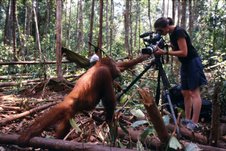
One of our kit sponsors, Miller Camera Support in Australia, recently sent us this image. Taking inspiration from the production still below, the image has been touring the world in their trade fairs. Whilst the interpretation of the orangutans has obviously been subject to creative license, the camerawoman is clearly a spitting image of Evie!

Cockroach Productions Inspires Miller Advert


Investigating the camera

Wednesday, October 04, 2006

Carbon Dioxide, Peat, Indonesia, Orangutans...

An Article from New Scientist in 2002, but still as relevant four years on as huge swathes of forest are cleared from peat domes, under the guise of palm oil development. It is important to note that oil palm does not grow well on peat, it falls over, machinery sinks, and the fire risks should mean that previously cleared, dry lowland should be used before opening peat swamp forests. We shouldn't even need to raise the point that peat swamp forest is one of the last refuges for orangutans!
N.L., OFPP

Indonesian wildfires spark global warming fears

19:00 06 November 2002
Copyright NewScientist.com news service 2002
By Fred Pearce

Burning peat bogs in Indonesia are releasing massive amounts of carbon dioxide into the atmosphere, in a repeat of the environmental devastation that made headlines around the world five years ago.

Tropical peat bogs, such as those beneath the forests of Indonesia, are among the planet's largest stores of carbon. They release much more CO2 when they burn than when the trees that grow on them catch fire.

Now a team of scientists from Britain, Germany and Indonesia has reported that as Indonesia's forests burned in 1997, the smouldering peat beneath released as much as 2.6 billion tonnes of carbon into the air.

That is equivalent to 40 per cent of the global emissions from burning fossil fuels that year, and was the prime cause of the biggest annual increase in atmospheric CO2 levels since records began more than 40 years ago.

Deep burn

The researchers calculate that, in 1998, the atmosphere contained almost 6 billion extra tonnes of CO2, compared with an annual average for the 1990s of 3.2 billion tonnes. Researcher Susan Page of the University of Leicester estimates that the smouldering peat bogs lost between 25 and 85 centimetres in depth.

Indonesian bogs burning during this year's El Niño are again spreading smog across southeast Asia, says her colleague Jack Rieley of the University of Nottingham. "The burning is likely to be around 40 per cent of 1997 levels, releasing up to a billion tonnes of carbon," he told New Scientist.

Formed over the past 20,000 years, Indonesia's peat bogs are up to 20 metres deep. Huge areas have been drained for agricultural projects in recent years. This leaves the peat dry and prone to fires spread when farmers clear the forest, especially when the rains fail in El Niño years.

In 1997, only 4.5 per cent of the pristine swamp areas burned, compared with 70 per cent of swamp beneath fragmented forest, the study found.

Carbon credits

As much as 50 billion tonnes of carbon is locked up in Indonesia's peat bogs - the equivalent of eight years of fossil-fuel emissions. Rieley predicts that it could all be released into the atmosphere over the coming century, adding to global warming.

David Schimel of the National Center for Atmospheric Research in Boulder, Colorado, says the study reveals how "catastrophic events affecting small areas can have a huge impact on the global carbon balance."

Rieley is now calling for an international effort to save the bogs. He says the Kyoto Protocol on climate change, which issues "carbon credits" to countries planting new forest to soak up CO2, should be extended to allow countries to claim credits for protecting key carbon stores such as peat bogs. Selling the credits to polluters could finance conservation projects, he says.

Journal reference: Nature (vol 420, p 61)

Tuesday, August 15, 2006

Wednesday, August 02, 2006

Morrisons to Join RSPO

Congratulations Letter Writers and Postcard Senders!


Morrisons have just announced that they are joing the RSPO, which means together we have managed to get that huge step forward in the campaign by getting all FIVE of our target supermarkets in the UK to sign up to principles of sustainability on palm oil. Next job: we need to get some politcal will-power in SE ASIA to only pursue sustainable palm oil production. More news on that will be coming soon. Meanwhile here is Morrisons' press release:

Morrisons to join Roundtable on palm oil

2nd August 2006

Morrisons has announced its intention to join the Roundtable on Sustainable Palm Oil (RSPO), to further demonstrate its commitment to the responsible sourcing of this ingredient and to help promote the growth and use of sustainable palm oil.

The company will continue to work with its suppliers to make progress in ensuring that any palm oil used in own brand products is from verifiable, sustainable sources.

“We have always been in accord with the aim of the RSPO and to address the issue, we focused on working directly through our supply chain”, said Corporate Affairs Director, Chris Blundell. “Given the global nature of the palm oil market there is the need for collective action on an international basis and the Roundtable process provides the best means of achieving this.”

Wednesday, July 12, 2006

Palm Oil Advert in British National Newspaper/s

Palm Oil Advert

Cockroach Productions' Orangutan Film Protection Project supplies the photo for Friends of the Earth's newspaper advert campaign.

Friends of the Earth said:

"We have already been contacted by Morrisons, who wanted to know if there was a specific reason why we felt we had to take the advert and also what we wanted to achieve by it. They appeared to be unaware that they were the last notable UK supermarket who hadn't joined the RSPO after Tesco announced they will join last week."

Certainly we, at the OFPP, have personally spoken with Morrisons on three or four occassions in the last few months urging them to develop a policy on sustainable palm oil, and was met with litle interest, or signs of proaction on their part. They had a fair warning that this issue would be likely to bring them some negative publicity if they did not act.

Thursday, June 22, 2006

Momentous Breakthrough in Campaign!

TESCO Joins the Roundtable on Sustainable Palm Oil, finally!!! Thank you to all our letter writers for your continued support and the pressure you have put on TESCOs - you have been successful.
And here is their press release:

TESCO TO JOIN SUSTAINABLE PALM OIL GROUP

Tesco today announced that it will join the Roundtable on Sustainable Palm Oil to help the industry identify ways of sourcing this widely used ingredient more responsibly.

Announcing the move, Group Corporate and Legal Affairs Director, Lucy Neville-Rolfe said:

"We are deeply concerned about the loss of rainforest - and the orangutans it supports - and believe that we can make a real contribution to work in this important area.

"It is a complex problem and our technical team have learnt a lot about the issue over the last two years and we hope that by sharing our knowledge and ideas, we will make a positive contribution and help to make a difference.”

Stanley Jonhson, former MEP and senior advisor to United Nation's Great Apes Survival Project (GRASP) welcomed the statement:

"This is tremendously good news. Given the enormous range of products containing palm oil marketed by Tesco in stores across the UK, it is vital that Tesco should join the Roundtable on Sustainable Palm Oil – as they now have. And given Tesco's increasing international operations, constructive participation from Tesco is likely to be even more important in the future."

Tesco House, PO Box 18, Delamare Road, Cheshunt, Herts EN8 9SL
Press Desk - Tel: 01992 644645

Wednesday, June 07, 2006

OFPP back in the field

We're back off to Indonesia tomorrow for a month's filming to complete the conflict mitigation training video. This video will show plantation workers what do when they encounter an orangutan - showing how to best ensure their personal safety and the safety of the orangutan. We will be working the Borneo Orangutan Survival Foundation to create a number of reconstructions to complete the training video. We'll try and keep you up to date while we're away.

We should remain in email contact periodically - so please drop us a line at info@cockroach.org.uk
We will return to the UK on the 9th of July. We plan to have the video completed by mid-July

Wish us luck!

Friday, May 12, 2006

BBC1 16:30 Really Wild Show, Weds 17th May

Palm Oil story reaches a Younger Generation

Those of you in the UK keep your eyes peeled for the Really Wild Show on the BBC this Wednesday (May 17th) at 4:30pm. The show will feature a special report on the palm oil industry and its negative implications for the protection of rainforests and biodiversity in Indonesia and Malaysia.


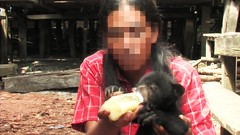
Some of the footage shot by Cockroach Productions on location in Borneo and Sumatra will be included in the report, including rare film of a captured baby sun bear, a baby macaque being kept as a pet in a palm oil plantation in Central Sumatra, and an unusual shot of a (completely arboreal) gibbon running bipedally across cleared forest land.


Hopefully the show will inspire a new generation of budding conservationists to join the campaign.

Tuesday, May 02, 2006

Orang-utan campaign heads to Westminster

Tuesday, 02 May 2006 08:35 Copyright InTheNew.co.uk

Orang-utan campaign heads to Westminster

Leading members of Britain's campaign to save endangered orang-utans are to lobby MPs at a Westminster reception this evening.

Hosted by Lib Dem MP Norman Baker and organised by Friends of the Earth, the event will be attended by prominent orang-utan campaigners including celebrity actress Joanna Lumley.

They will attempt to highlight the plight of the orang-utans, whose rainforests are being steadily destroyed by Britain's demand for palm oil, in an attempt to gain changes to the company law reform bill currently passing through parliament.

"Demand for palm oil is threatening the survival of these fantastic creatures and it is shocking that our demand for cheap food and other products is behind this," Mr Baker, the party's environmental affairs spokesperson, said.

"I believe we must take this opportunity to use the company law reform bill to ensure that UK companies take more responsibility for the impacts they have on the environment."

At present British supermarkets including Tesco, Somerfield and Morrisons are refusing to subscribe to an agreement on the "sustainable use" of palm oil, showing a disinterest the bill could forcibly change.

"The growth in demand for palm oil is putting pressure on precious areas of rainforest in Borneo and Sumatra, threatening the survival of the orang-utan," Friends of the Earth oil campaigner Ed Matthew said.

"MPs have the power to do something about this and we urge them to take this chance."

Palm oil, harvested from the rainforests of Borneo and Sumatra, can be found in one in ten products sold in Britain's supermarkets.track
_____________________________________
The Orangutan Film Protection Project Team from Cockroach Productions will be attending this event and showing a video report from Indonesia, highlighting the plight of orangutans and local people in the face of the growing palm oil industry. Our hope is to rally British Government support for the sustainable sector of the industry, being led by the Roundtable on Sustainable Palm Oil.

Find out more at www.cockroach.org.uk